What work will look like in 2035 if AI keeps evolving at this pace
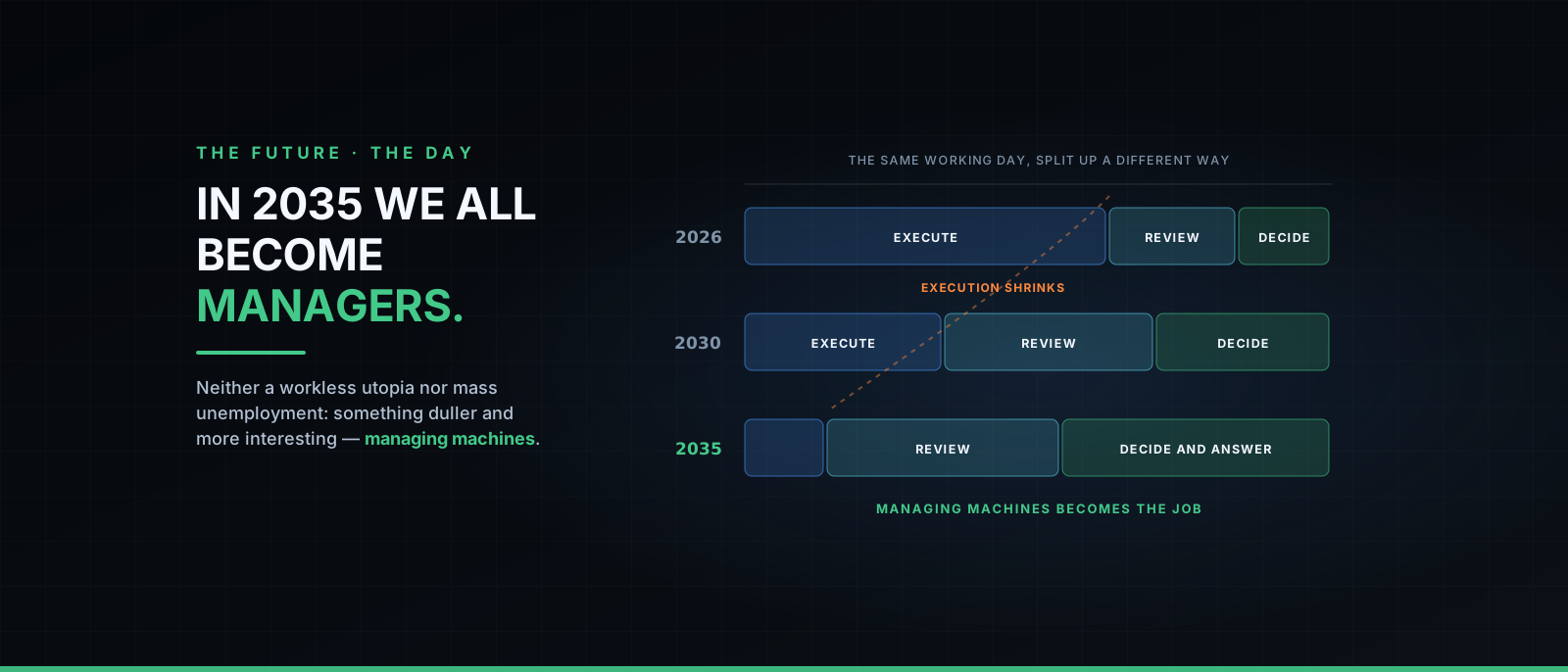
Neither a workless utopia nor mass unemployment. The likeliest scenario is duller and more interesting: everyone becomes a manager of machines.
One caveat before we start
A ten-year forecast in technology is wrong by default. Whoever predicted 2026 back in 2016 got very little right: nobody put "the machine writes text and code better than the average person" on the list.
So treat what follows as a scenario, not a prophecy — and watch mainly the premises, which are the part you can check along the way.
Central premise: the technology keeps evolving fast, but adoption stays slow. That lag between what the technology allows and what organisations actually change is the most stable thing in economic history, and it is what sets the shape of 2035.
What will probably be true
Almost all office work will have a system in the middle. Not as a tool you open, but as a layer the work passes through: it prepares, proposes, runs the repetitive part, flags the exception. The person steps in at the decision and at the exception.
The average role becomes supervision. The useful analogy is the factory. The worker who assembled parts became an operator who looks after an automated line — fewer people, more qualification, and the job became watching, adjusting and solving whatever falls outside the standard. The office is making that same crossing, three decades later.
Fewer entry-level jobs, higher demands at the door. The trend that is already visible gets consolidated. Training new professionals becomes a structural problem, and the companies that solve it — with a training programme of their own, because the natural conveyor belt broke — will have an enormous hiring advantage.
In-person and physical work gains value. Manual trades, care, teaching, health, everything that requires a body and a presence. Not out of nostalgia: out of relative scarcity.
Working hours fall slowly, and not to zero. Productivity gains historically turn into a mix of more output, more consumption and slightly shorter hours. A four-day week across a relevant share of the market is plausible; the end of work is not.
What will probably not be true
Permanent mass unemployment. The historical pattern is recomposition, not elimination. The pain belongs to the transition and it is concentrated — which is bad enough without any exaggeration.
Universal basic income as a settled answer. It stays under debate, with local experiments. Policy moves far more slowly than technology.
Nobody programs, writes or designs any more. There are still people in those roles, doing more volume, with more responsibility and less typing.
Empty offices run by agents. A company is an arrangement of responsibility and trust between people. That does not get automated, because it is not a technical problem.
The three changes that will bite hardest
1. The end of the CV as proof. If anyone can produce an impeccable portfolio in one afternoon, what counts is what you can defend live, in depth, under a hard question. The interview goes back to being a real technical conversation, and verifiable reputation is worth more than a diploma.
2. Hiring for judgment, not for output. Companies will stop measuring the volume delivered — because volume got cheap — and start measuring decisions made well. That is a far harder metric, and companies will get it wrong plenty before they learn.
3. Explicit responsibility over autonomous systems. It becomes part of the job description: who answers for what the system did. This is already entering regulation and it will reach the employment contract.
In 2035 the interview question will not be "what can you do?". It will be "what do you decide, and how do you prove you decided well?".
What to do today, without betting on any scenario
The four things below pay off in any future — including one where AI slows down:
- Stand on the side of judgment. Close to the problem, the risk and the decision; far from repetitive execution.
- Accumulate specific and tacit knowledge. The kind you only learn inside a domain, talking to the people who do the work. It is what no model picks up from a repository.
- Learn to verify. Assessing machine-generated work in your field will be asked about in every interview.
- Keep the ability to start over. Whoever has already switched technologies three times switches a fourth without drama. The ability to relearn is the only asset with a guaranteed shelf life.
The close
Every technological wave arrived with the promise of the end of work and delivered different work — usually more abstract, better paid for whoever kept up and harder for whoever could not.
There is no strong reason to think the pattern flips this time. There is plenty of reason to think it moves faster this time — and that is why the conversation about who funds the transition matters more than the conversation about robots.
Get the next articles
No spam. One message when a new article is out, with an unsubscribe link in every one.