How small companies can use AI to compete with big ones
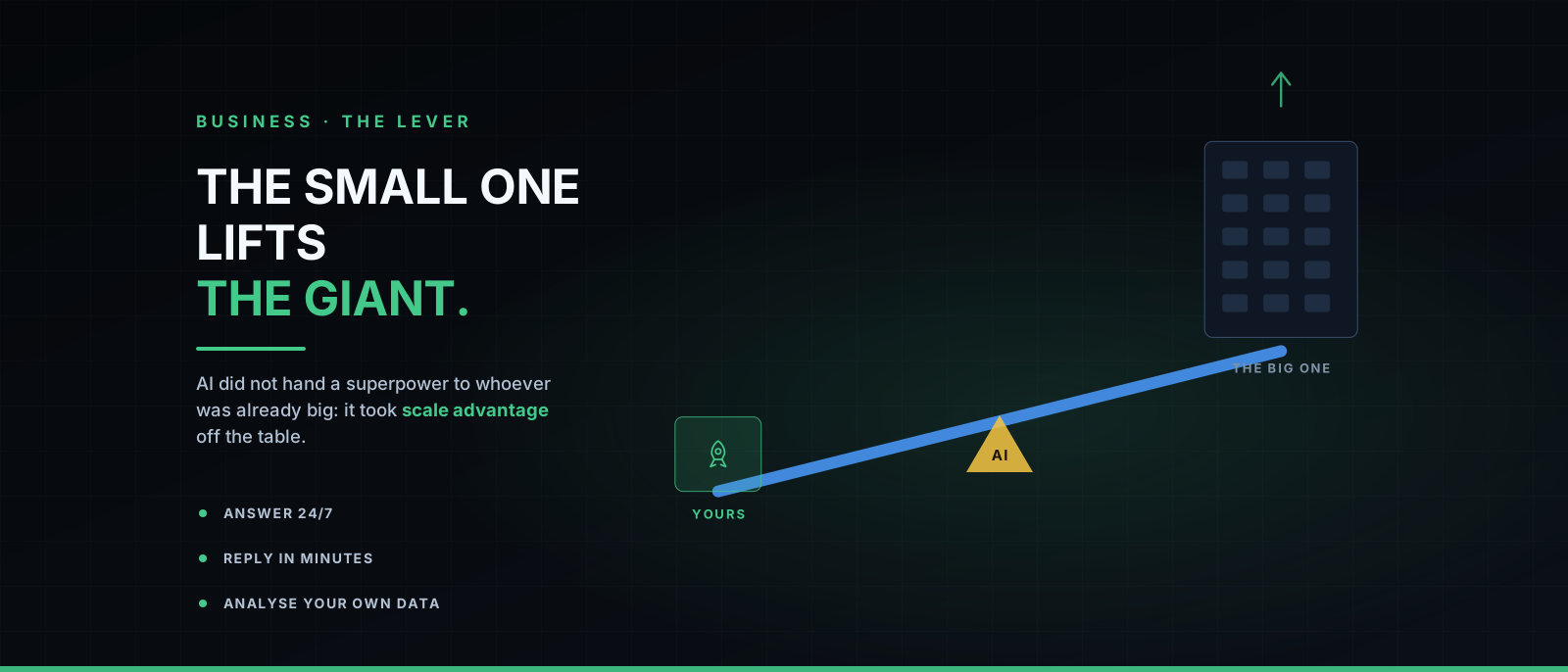
AI did not hand a superpower to whoever was already big. It took the advantage of scale off the table — and that favours whoever is small and fast.
The advantage that turned inside out
For a long time, technology was a game of scale: whoever had more people, more data and more budget came out ahead. A decent customer service system cost six figures and a year of project work.
AI reversed part of that. Today, capability that used to demand a whole department sits one subscription away — and it costs the same for the company of five people and for the one of five thousand.
The advantage left for the big player is proprietary data and distribution. The advantage that moved to the small one is speed of decision. While the big company assembles an AI governance committee, you have already tested three things and kept the one that worked.
Where the small player really wins
Let us be specific, because "use AI" is not advice.
Support that answers right away. The customer who sends a message at 9pm and gets a useful answer at 9:01pm does not compare you with the big company — they compare you with the competitor who replied on Tuesday. An assistant trained on your catalogue, your policies and your history of questions solves most of it before it reaches a person.
Content production at big-company pace. Product descriptions, emails to your list, posts, scripts, commercial proposals. The bottleneck here was never creativity; it was person-hours. That bottleneck fell.
Invisible administrative work. Reconciliation, expense categorisation, contract reading, meeting summaries, pulling data out of PDFs. It is the work nobody sees and that eats the nights of the owner.
Analysis you could not afford. Asking your own sales data in plain language — "which customers used to buy every month and stopped?" — used to be a BI project. It became a conversation.
Expertise on demand. A contract draft, a text review, a first reading of a tender, a translation. It does not replace the lawyer; it shortens the conversation with them and cuts the bill.
The classic mistake: starting with the website chatbot
Almost every small company starts at the most visible and least profitable place. The chatbot on the home page is the most photogenic and least lucrative thing AI does.
The path that pays starts somewhere else: the process that eats the most hours of the most expensive person in the company. Usually that is the owner, and usually it is something done at night because they do not trust delegating it.
A four-week script
Week 1 — Map, do not automate. Write down every repetitive task on the team for one week, with an estimated time. No judging, no choosing. You will be surprised by what shows up.
Week 2 — Pick one. Criteria: it happens at least once a day, it has a recognisable right answer, and getting it wrong costs little. Start with what is frequent and cheap to get wrong.
Week 3 — Do it by hand, with AI in the middle. No project. One person, one tool subscription, one good prompt kept in a shared document. Measure: how long it took, how long it takes now.
Week 4 — Decide. Clear gain? Write the procedure, train one more person, and only then think about automating for real. No gain? Drop it without regret and move to the next item on the list.
A small company should not run an AI project. It should run an AI experiment — cheap, short and disposable. Twelve experiments a year beat one twelve-month project.
What it costs and what to avoid
For most small businesses, the real cost of starting sits at one or two professional subscriptions a month. That is less than a day of consulting. The big spending, when it appears, comes from custom projects contracted far too early.
Three traps that always show up:
- Buying a platform before having a process. A tool does not organise what is messy; it speeds the mess up.
- Putting sensitive data into a tool that trains on it. Check the data usage policy before uploading a client contract anywhere. Business plans usually carry an explicit no-training clause; use them.
- Automating the decision along with the task. Let AI prepare; keep the decision with the person. Especially when money, customers and reputation are involved.
The point that matters
The big company will get there too — with more money, more data and more people. What it will not have is your ability to decide on Thursday and be running on Friday.
While that window is open, the small player plays with an advantage. It does not stay open forever.
Get the next articles
No spam. One message when a new article is out, with an unsubscribe link in every one.