The biggest myths about artificial intelligence that still confuse people
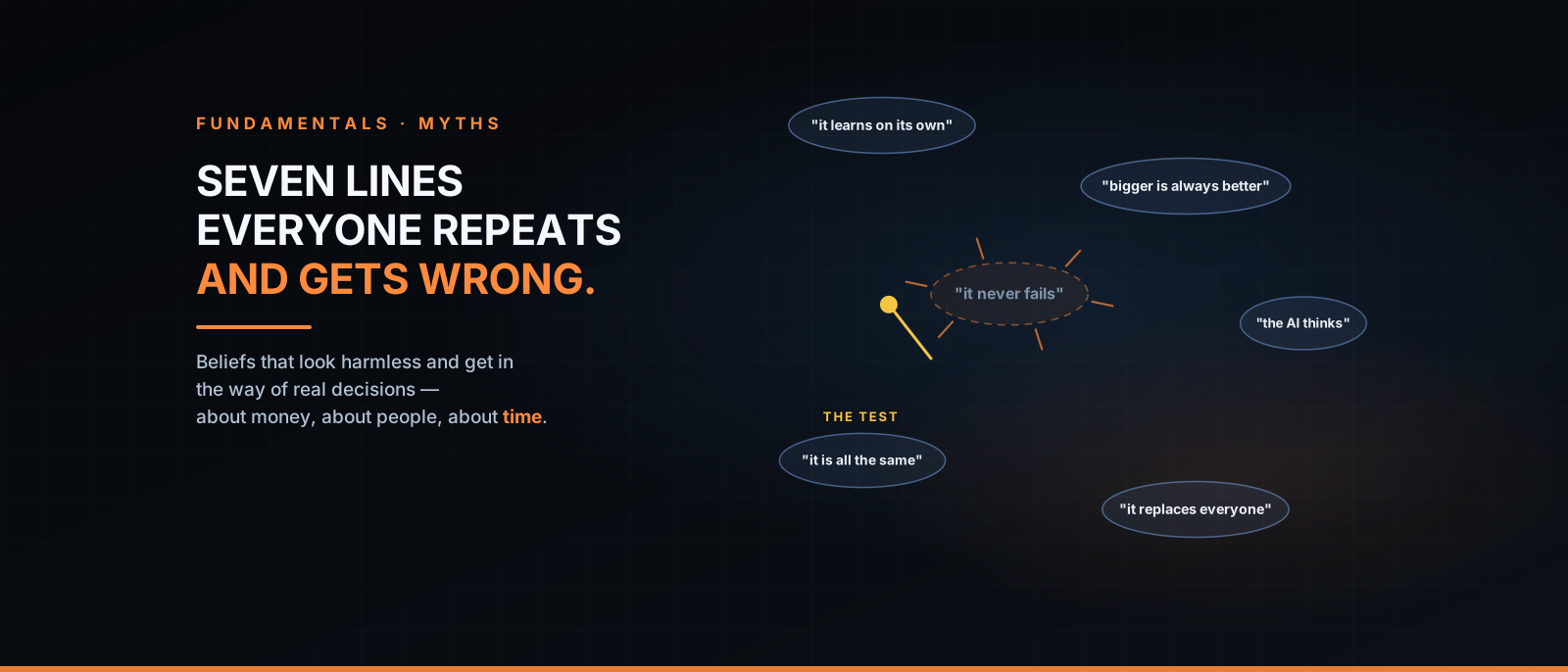
Seven beliefs that get in the way of real decisions — from "it learns from you as you chat" to "the bigger the model, the better".
Why this matters
A myth about AI is not bar-table trivia. It turns into the wrong decision: a company that stays out of it from unfounded fear, a company that overuses it from unfounded confidence, people studying the wrong thing.
Seven myths, from the most common to the most expensive.
Myth 1: "It learns from our conversations"
This is the most universal one. The intuition comes from the name: if it is machine learning, it must be learning while we talk.
It does not work that way. The model you use was trained once, before it ever reached you, and it is frozen. It keeps nothing of your conversation in its own weights. When it seems to remember, that is because the dialogue history is resent with every message, or because the product saved notes about you in a separate database and injects them into the context.
Why it matters: people stop correcting the model because "it will learn anyway", and people panic thinking a company secret has become a neural network weight. The legitimate worry is a different one — whether the provider uses your conversations to train future versions — and that is a contract clause, not a property of the technology.
Myth 2: "It understands what it is saying"
Here the philosophical debate runs long, but the practical part is simple: the model produces the most likely continuation for a text, based on regularities absorbed from a gigantic volume of material.
That produces something that looks a great deal like understanding most of the time, and fails in a characteristic way: with total confidence, without signalling any doubt. A human who does not know hesitates. The model does not hesitate — the fluency of an answer has no relationship to the certainty of its content.
Rule of thumb: fluency is not evidence.
Myth 3: "Hallucination is a bug they will fix"
Hallucination is not an implementation defect; it is a direct consequence of how the thing works. A system that generates the plausible continuation will sometimes generate something plausible and false. Reducing it is doable — search against a real source, cross-checking, answers with citations, models that admit they do not know. Zeroing it is not.
That is why every serious use of AI carries one question: what happens if this answer is wrong? If the answer is "nothing much", ship it. If it is "damage", put verification in the middle.
Myth 4: "The bigger the model, the better"
It was true for a while and became outdated common sense. Today small, specialised models beat giants at specific tasks, at a fraction of the cost and in less time — sometimes running on your own machine.
The right question is not "which is the biggest?" but "which is the smallest that solves my case with room to spare?". Sorting email into three categories does not need the frontier model; writing the legal strategy of the company does.
Myth 5: "AI is objective because it is mathematics"
This is the dangerous one. The model inherits the patterns of the material it was trained on — which is human production, with every bias that carries. Add the choices of whoever tuned the behaviour of the model, and the result is anything but neutral.
Where it really hurts: CV screening, credit analysis, risk assessment. In any process that decides about the life of a person, "the AI chose" is an unacceptable answer.
Myth 6: "It is going to become conscious"
The conversation about machine consciousness fuels endless debate and gets in the way of the decisions right in front of you. A system optimising a function does not need to want anything in order to cause harm — it is enough for it to be applied where it should not be, with too much autonomy and too little supervision.
The realistic risk of 2026 is not the machine waking up. It is the machine being used too fast, on an important decision, with no trace of who authorised what.
Myth 7: "It is going to replace the jobs"
Full replacement is rare; recomposition is the rule. What changes is the mix of tasks inside the same role, and what usually happens is that the professional produces more volume with the boring part handed off.
Except there is a truth hidden inside the myth: whoever had the whole job made of tasks AI does well — transcription, simple triage, routine translation, the first draft of standardised text — feels it for real, and feels it now. It is not the end of work; it is the end of one band of it.
The historical pattern is clear: technology rarely erases a whole profession. It erases the most repetitive part and raises the demands on what is left.
The antidote
Just one, and it serves all seven: test it on your own case. Every generic claim about AI — mine included — is worth less than half an hour of experiment with your data, on your problem, with your own criterion for what counts as right.
Get the next articles
No spam. One message when a new article is out, with an unsubscribe link in every one.