The rise of the Agent Engineer: the new profession of the AI era
Calling a model through an API is integration. Making an agent work on its own, with tools, memory and limits, is engineering — and people are being hired just for that.
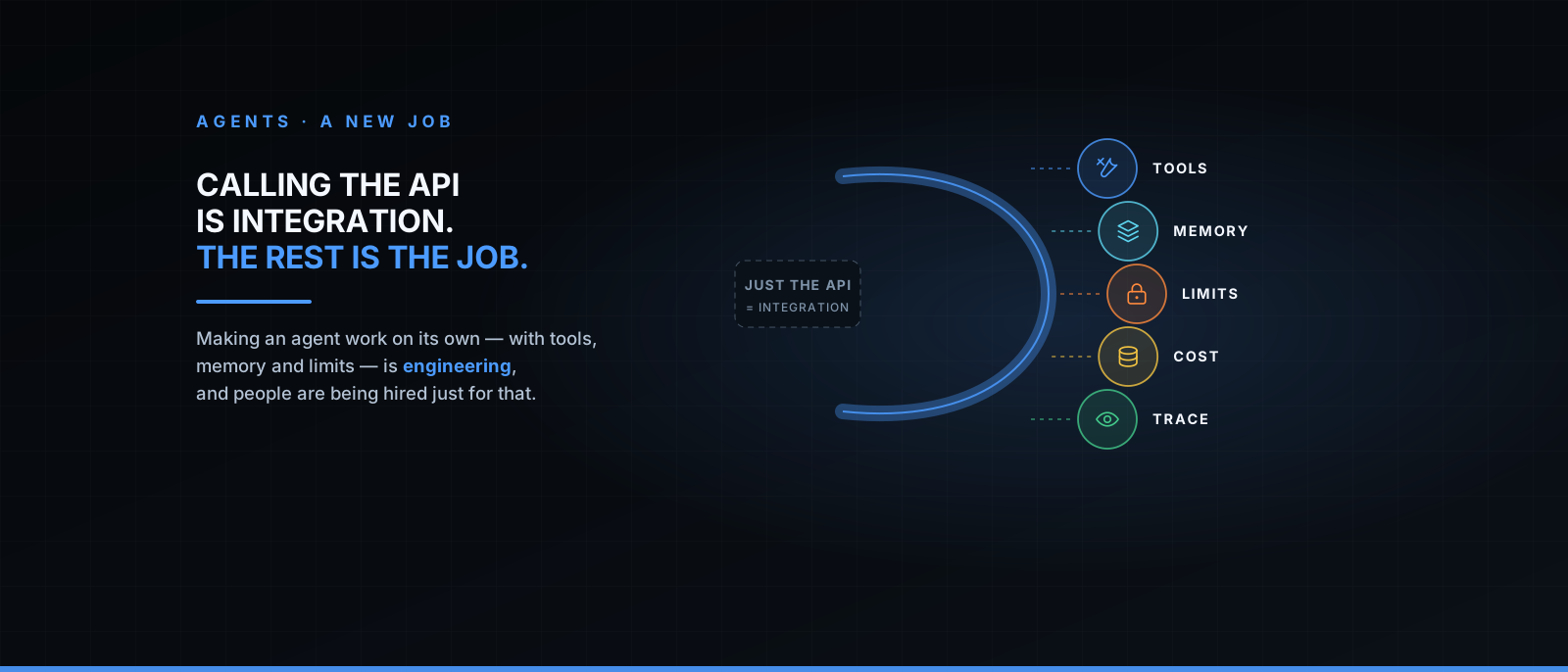
A job that did not exist
Two years ago, "using AI" in a company meant putting a chat box on the screen and calling an API. The work fitted in a sprint and the job title was the usual one: developer.
Today there is a function that fits no old title. The person who designs how an agent decides: which tools it may call, what goes into the context window, what it does when a tool fails, how far it may go without asking, and how you prove afterwards that it did what it should. That is not integration. It is the design of an autonomous system.
That person is the Agent Engineer.
Agentic AI, in one honest sentence
Generative AI produces content when you ask. Agentic AI executes a goal over several steps, choosing the actions along the way by itself.
The practical difference is the loop. A generative model does: input → output. An agent does: goal → thinks → picks a tool → observes the result → decides the next step → repeats until it finishes or gives up.
That loop changes everything. It introduces state, variable cost, partial failure and side effects in the real world — the four things that turn a product feature into an engineering problem.
The tools are the agent's body
A model with no tools only knows how to talk. Tools are what give it arms: query a database, open a ticket, send an email, read a file, call the ERP's API.
Designing tools is the most underestimated half of the work. A well-made tool:
- Does one thing, and the name says which.
find_order_by_tax_idworks;run_queryis an invitation to disaster. - Has validated input and readable errors. The agent reads the error message and tries to correct itself — so the message is a prompt, not a log line.
- Returns little. Returning a two-hundred-line JSON burns context and drowns the next decision.
- Is reversible or asks for confirmation. A destructive action with no confirmation is an accident waiting for a date.
MCP: the standard that made this scale
Until recently, every agent had its tools hand-glued inside its own code. That does not scale: ten agents reaching the same CRM meant ten different integrations.
MCP (Model Context Protocol) solved it the boring, correct way: it became an open protocol for exposing tools, data and instructions to any model. You write an MCP server for your CRM once, and any compatible agent knows how to use it — from the assistant in your editor to the agent that runs on the server at midnight.
The cultural effect is bigger than the technical one. MCP turned "AI capability" into something you publish, version and govern — the way we have done with APIs for twenty years. It is the difference between a hack and infrastructure.
What the Agent Engineer actually does
The day to day is far less glamorous than the title suggests:
- Narrows the goal. An agent with too broad a scope fails in creative ways. The work starts by cutting the task down until it fits in a reliable loop.
- Budgets the context. Decides what goes into the window, what goes to external memory, what is summarised and what is discarded. Context is a budget, not a warehouse.
- Designs the failure. What happens when the API goes down, when the model hallucinates a parameter, when the loop does not converge? Timeout, maximum number of steps, an emergency exit to a human.
- Instruments everything. Every step, every tool call, every token spent, traceable. With no trace there is no debugging — and an agent you cannot debug is a bet.
- Measures. A set of evaluation cases with expected answers, run on every change of prompt or model. Without that, "it got better" is an opinion.
- Defines the boundary of autonomy. What it does alone, what it proposes and waits for approval on, what it never does.
Half the work of an agent engineer is deciding where the autonomy ends. It is the only half the board will actually ask about.
Where these people come from
Not from a course. The people who are good at this today arrived by three paths: backend development (which already understands distributed systems, queues, idempotency and partial failure), operations/SRE (which already lives on observability and postmortems) and process automation (which already knows how to model an area's work before automating it).
Whoever only knows how to write prompts does not get there. The prompt is one of the layers — and the easiest one to swap.
Why this becomes a profession and not a fad
Because the problem is not in the model, it is in the system around it. Every model generation improves and the engineering work remains: someone has to decide limits, guarantee traceability, control cost and answer when the agent does something stupid.
Better models make agents more capable — which increases, rather than reduces, the need for someone who knows where to put the leash.
Get the next articles
No spam. One message when a new article is out, with an unsubscribe link in every one.