How to use ChatGPT without becoming dependent on it
The tool that makes you produce more can make you think less. You can keep the first effect without paying for the second.
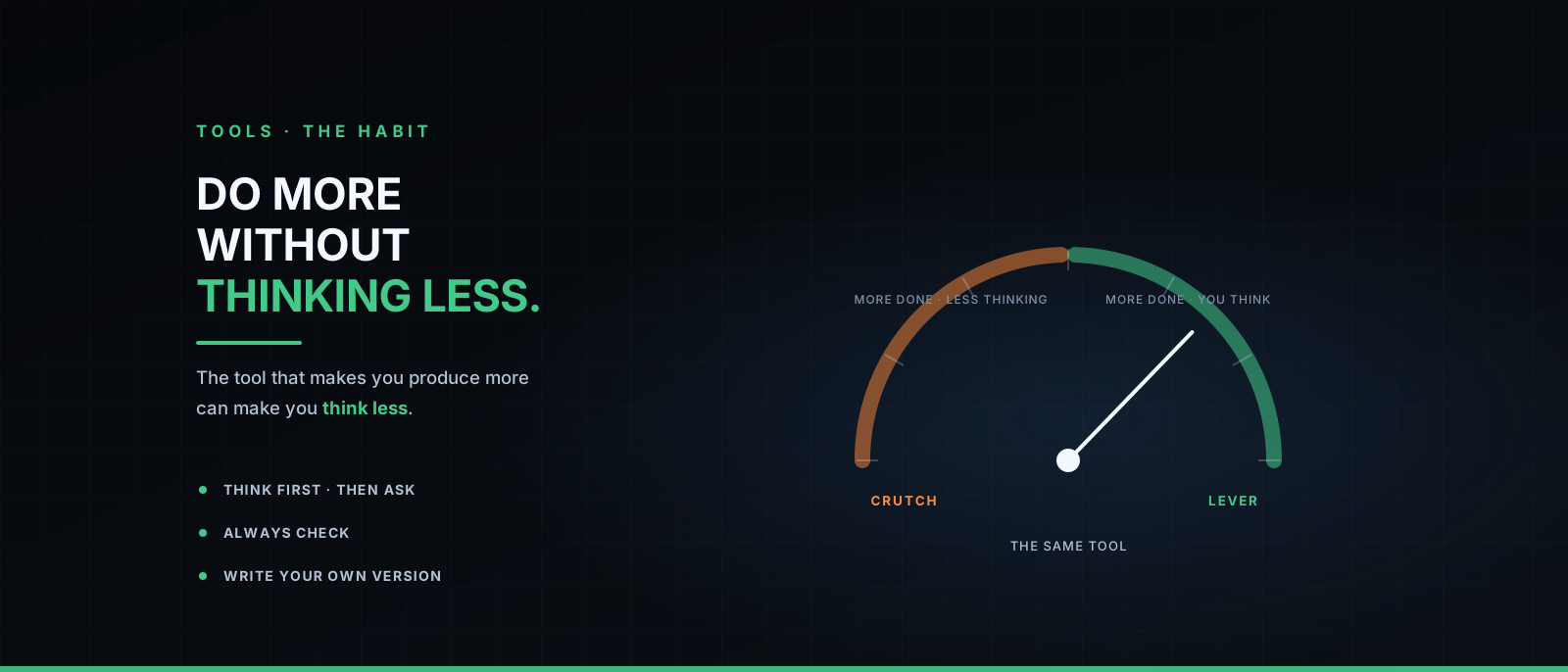
The risk is not what it looks like
The common fear is getting "addicted" to the tool. The real risk is subtler: atrophy. You keep delivering well, you just quietly lose the ability to do it without.
That is neither new nor a catastrophe. Nobody does square roots on paper any more, and no harm comes from it. The problem starts when the capability you outsourced is exactly the one holding up your judgment — because judgment is what stays valuable when execution gets cheap.
Five signs you went past the point
An honest self-diagnosis:
- You ask before you try. The reflex to open the chat comes before the reflex to think for thirty seconds.
- You cannot explain what you delivered. If someone asks "why like this?", the truthful answer would be "that is what came out".
- You accept the first answer. Nothing strikes you as odd, nothing gets checked, ever.
- The blank page paralyses you. Starting from zero, with no generated draft, got hard in a way it was not before.
- You lost the yardstick. You can no longer tell whether a text or a piece of code is good — only whether it "looks" good.
Items 2 and 5 are the serious ones. The others are habit and get fixed in a week.
The rules that work
No abstinence. What works is a rule of use, and these five solve nearly everything.
Try first, for a defined amount of time. Five minutes on your own before asking. It is not moralism: the value is in you formulating the problem clearly before delegating it — and whoever tried first asks a much better question.
Ask for the path, not the answer. "Give me three approaches with the downside of each" preserves your decision. "Do this for me" hands it over. The first form teaches you; the second replaces you.
Rewrite whatever comes back. Never paste it raw. Running the text through your own hand forces you to understand every part and, as a bonus, keeps your voice — which is the one thing the machine does not have.
Separate the zones. Decide in advance where AI comes in freely (drafts, boring tasks, things you already master and do not want to repeat) and where it does not (whatever you are learning right now, and the final decision on anything important). Learning requires the friction the tool removes.
Keep one day without. One day a week doing it the old way. It works as a gauge: if it hurt a lot, you found out the size of the dependence before it charged you dearly.
Use AI for what you already know how to do and do not want to do again. Do by hand what you are still learning to do.
The case of someone starting out
For students and early-career professionals the calculation is different, and it is worth being blunt: the shortcut costs you more.
Whoever has ten years on the road uses AI as a lever — they have a yardstick for judging the result, because they built that yardstick by making their own mistakes. Whoever is starting out and skips the mistake-making phase builds no yardstick at all. They end up dependent on a judgment that is not theirs, and the market notices it at the first hard interview question.
It is not "do not use it". It is: use it as a teacher, not as a supplier. Ask for an explanation, ask for corrections on what you did, ask for the counter-argument to your solution. Avoid asking for the finished product in the very thing you want to master.
A monthly test
Once a month, do one task from your job entirely without AI and compare it with what would have come out with it. You will discover one of three things:
- It came out similar → you are using it as an accelerator. Excellent.
- It came out worse, but you got there → normal. All is well.
- You could not finish → here is the bill. Work on that area on your own for a while.
The goal is not to use less. It is to remain capable of choosing.
Get the next articles
No spam. One message when a new article is out, with an unsubscribe link in every one.