The professions that will grow the most because of artificial intelligence
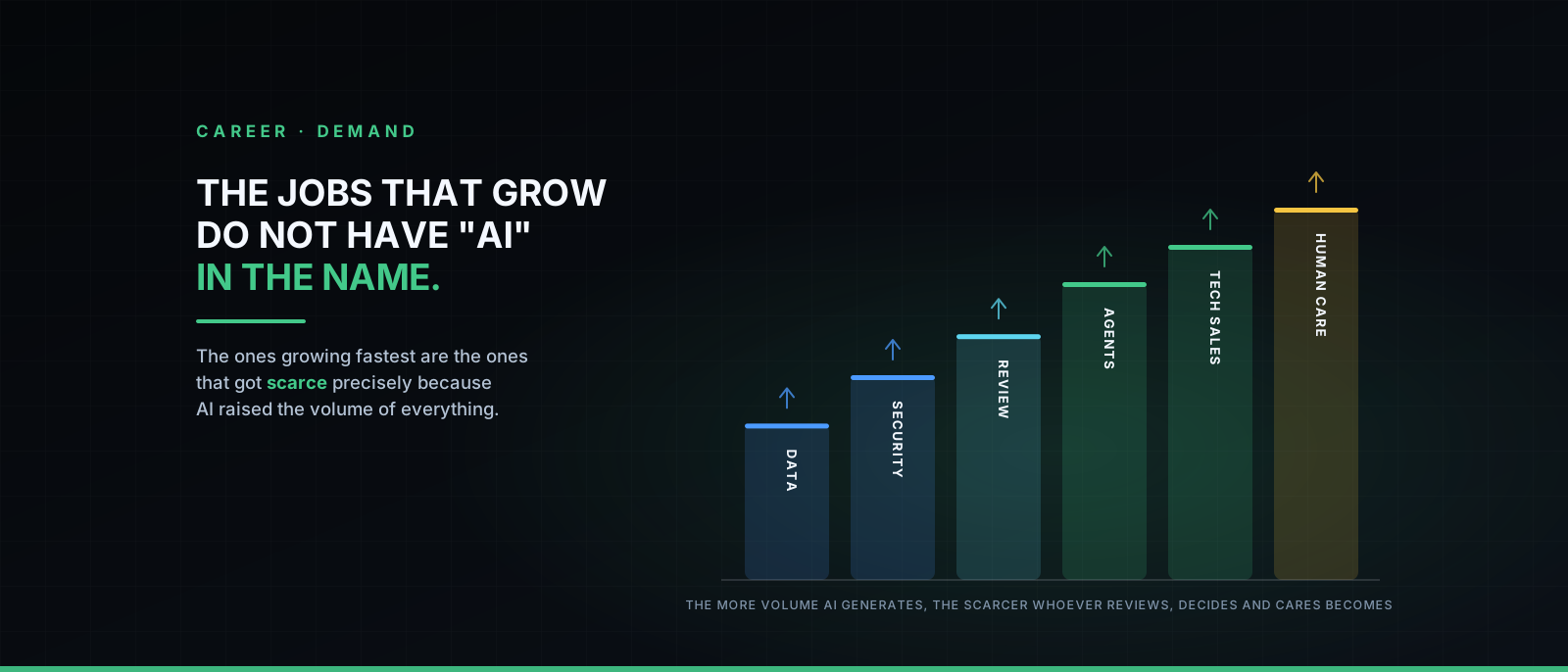
Not every new job has "AI" in the name. The ones growing fastest are the ones that got scarce precisely because AI raised the volume of everything.
The pattern that repeats
Every technology that massively increases the production of something creates scarcity on the outside: of raw material, of verification, of maintenance, of distribution.
The printing press multiplied books and created demand for editors, proofreaders and booksellers. The computer multiplied spreadsheets and created demand for analysts. AI multiplied text, code, images and automated decisions — and the scarcity showed up in whoever feeds, verifies and connects all of that to the real world.
That is how you can predict which roles grow. I split them into four blocks.
Block 1 — Those who build with AI
Agent Engineer. Designs systems that carry out tasks autonomously: tools, limits, memory, failure handling, observability. It is the newest role and the worst defined — which means whoever arrives early writes the definition.
Data engineer. The most underestimated role of this wave. No agent is better than the data it can reach, and the bottleneck in most companies is not the model: it is that the data sits in five systems that do not talk to each other.
Integration and automation specialist. The person who connects the model to the ERP, the CRM, the messaging channel and the legacy database. Unglamorous work and extremely high demand, because the last mile is where every AI project dies.
Product developer with AI inside. Does not "use AI": designs the experience around uncertainty — what to show when the model gets it wrong, how the user corrects it, how the product wins trust back.
Block 2 — Those who verify AI
This block grows quietly and is going to grow a lot.
Audit and compliance for automated systems. With regulation tightening in Europe and the subject advancing elsewhere, a company has to prove how the system decides, on which data and under whose supervision. That becomes a profession, the same way financial auditing did.
Information security focused on AI. A new and poorly understood attack surface: prompt injection, leakage through context, agents with too many credentials, sensitive data going to the wrong vendor. There is a shortage of people who understand security and models.
AI evaluation and quality. Whoever builds the test case set, measures regression between versions and answers "did it get better or worse?" with evidence instead of a feeling. Today it is done half-heartedly by whoever is left over; it becomes a role.
Specialist review. A lawyer reviewing a generated contract, a doctor validating triage, an engineer signing off a design. AI produces the draft; the professional signature stays human — and becomes the product.
Block 3 — Those who take care of the human side
Change management and training. The technology arrived; the people did not come along. Whoever can take an entire team from fear to competent use solves the bottleneck that most delays companies today.
Process design. Before automating, someone has to understand what the work really is — not what the flowchart says it is. That reading of real work is rare and does not automate.
Mental health and education. Two areas where human presence is part of the effectiveness, not a cost to be cut. AI comes in as support and extends the reach of whoever is already good.
Block 4 — Those who work with atoms
Worth saying plainly: physical trades became more valuable, not less.
Electrician, refrigeration technician, welder, installer, mechanic, nursing, construction. Work that requires hands, travel and improvisation in a messy environment is precisely the furthest thing from what a language model does. And demand for infrastructure — data centres, power, networks — is rising because of AI itself.
The safest prediction of this decade: we will run out of electricians before we run out of programmers.
How to position yourself
You do not need to change careers. You need to move within yours in the right direction:
- Go where judgment is required, not execution.
- Stay close to the proprietary data and the specific domain of your field — that is what AI does not have.
- Learn to verify machine-generated work in your area. That skill will be asked about in every interview for years to come.
- If your work is entirely digital and entirely repetitive, start moving now, calmly, while it is still a choice.
Get the next articles
No spam. One message when a new article is out, with an unsubscribe link in every one.