Will AI create more jobs or destroy jobs?
Both, and not in the same cities, nor in the same age brackets, nor at the same pace. That is where the problem lives.
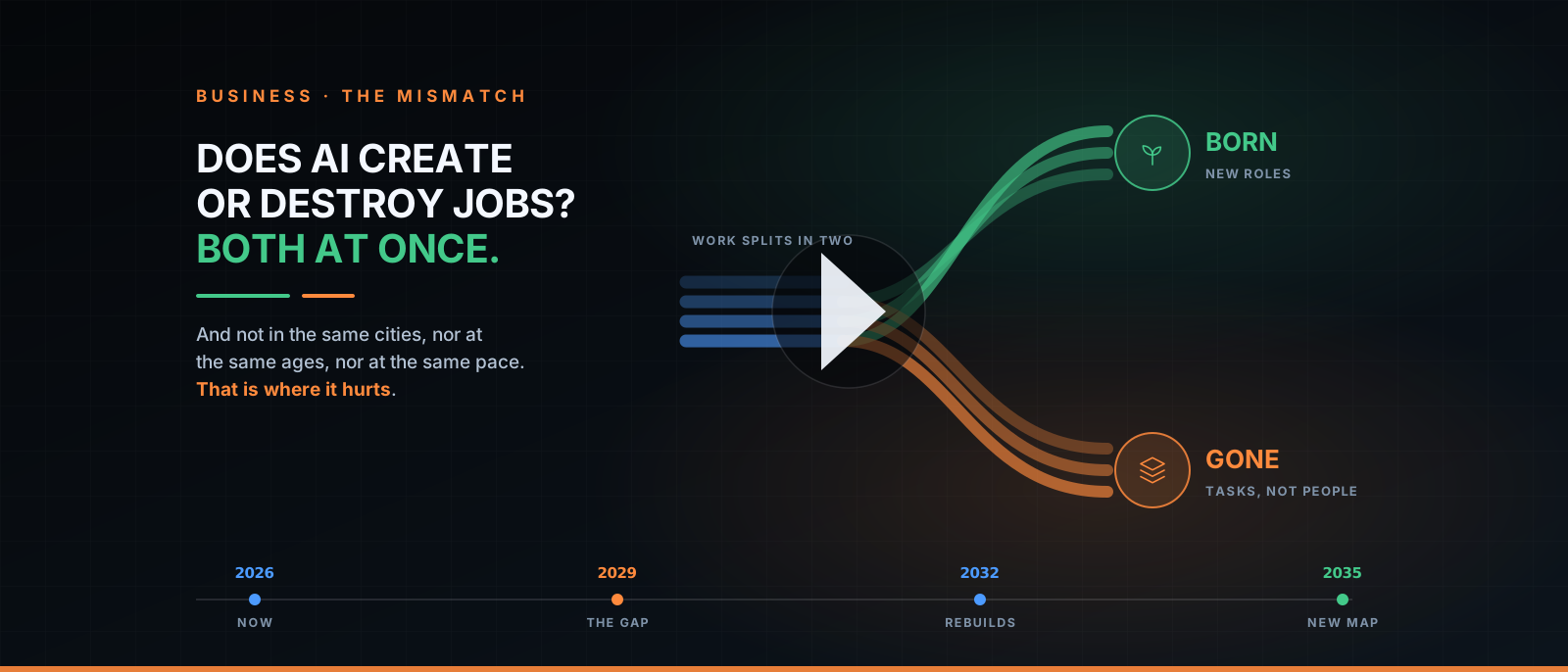
The boring answer is the correct one
Both, at the same time. And the public debate insists on picking a side, because one side makes a better headline.
What economic history shows with fair consistency is a pattern of three movements: concentrated destruction, diffuse creation, and a painful gap between the two.
Movement 1: destruction is concentrated and visible
When a technology drives down the cost of a task, the jobs made up mostly of that task disappear fast. It is concentrated — a specific sector, a specific region, a specific skill band — and that is exactly why it is visible and measurable.
In the current wave, the pressure shows up first in digital, standardised, high-volume work: transcription, routine translation, generic content production, simple support triage, the first draft of marketing material, and the most mechanical band of programming and design.
One detail the market data keeps showing, and that deserves attention: the impact lands at the entry door first. It is not mass layoffs of experienced people — it is junior hiring that never happens. That is quieter and just as serious, because it breaks the conveyor belt that produces the senior professional of ten years from now.
Movement 2: creation is diffuse and slow
The jobs created show up scattered, across different sectors, and take years to add up to a visible number. That is why pessimism always looks better founded in the short run: the loss has a name and an address, the gain has a statistic.
The classic example is the bank teller. When the ATM became popular, the obvious forecast was the end of the role. What happened was different: as running each branch got cheaper, banks opened more branches, and the work moved from counting money to selling products and solving problems. Headcount in the role took decades to fall — and it fell for other reasons, mainly the mobile phone.
The lesson is not "everything will be fine". It is that automating a task rarely equals eliminating the job, because a job is a bundle of tasks, and the economy answers falling costs by raising the volume.
Movement 3: the gap is the real problem
Here is the point almost everyone skips.
Even if the net job count is positive in ten years, that is no comfort to whoever lost their job in 2026. The jobs created demand other skills, appear in other places and are filled by other people — younger, more educated, more mobile.
The employment outlook reports of recent years — the Future of Jobs, from the World Economic Forum, is the most cited — converge on a similar diagnosis: they project millions of positions displaced and millions created at the same time, with a generally positive balance, and note that most workers will need meaningful reskilling this decade.
The net number matters less than the word reskilling. That is the real cost, and it is almost always paid by the person, alone, with no time and no money.
The question "does it create or destroy?" is less useful than "who pays for the transition?". Historically, the answer has been: whoever can least afford it.
What the recent evidence suggests
A few points that show up fairly consistently in the studies and in market data so far:
- The productivity gain is real and uneven. Field studies in customer support and writing show a larger gain among less experienced professionals — AI works as a leveller, pulling the beginner closer to good performance.
- Adoption is slower than the talk. The distance between "the company bought licences" and "the process changed" is measured in years, not months. That is what gives the transition its time.
- Demand for complementary skills goes up. Where AI comes in, the requirements for judgment, communication and supervision rise inside the very same role.
- Not every gain turns into a layoff. A good share of it turns into more volume produced by the same team — which you only notice by looking at the output, not at the headcount.
What to do with this
As a professional: your protection is not avoiding AI, it is standing on the side of judgment and responsibility, and never letting your work become entirely describable as a procedure.
As a company: automating with no internal redeployment plan is a short-term gain with a long-term cost in trust. The companies that come out of this decade in better shape are the ones that reskilled instead of replacing.
As a society: the useful discussion is not about the net job count in 2035. It is about who funds the training of whoever gets displaced in 2027 — and that conversation has barely started.
Get the next articles
No spam. One message when a new article is out, with an unsubscribe link in every one.